Building a Practical Preventive Healthcare Routine
Preventive healthcare has moved from the fringes of clinical practice to its center. Where medicine once focused almost exclusively on treating disease after it appeared, modern care increasingly emphasizes detecting risk early, intervening intelligently, and maintaining function over the long term. For technology professionals, knowledge workers, and anyone navigating a demanding schedule, the challenge is rarely a lack of awareness. It is the translation of good intentions into a sustainable system.
A practical preventive routine is not a collection of heroic efforts. It is a set of small, repeatable actions supported by data, calibrated to your risk profile, and integrated into the rhythms of daily life. This article outlines a framework for building that routine, from baseline assessment through long-term maintenance.
Why Prevention Deserves a System, Not Just Willpower
Most people approach health reactively. They visit a clinician when something hurts, schedule screenings when a reminder arrives, and adjust habits after a warning sign appears. This pattern is understandable, but it is also inefficient. Chronic conditions such as cardiovascular disease, type 2 diabetes, and many cancers develop silently over years. By the time symptoms surface, the options for intervention are often narrower and more invasive.
A structured routine changes the timeline. It converts vague goals like “get healthier” into measurable inputs: blood pressure readings, lipid panels, activity minutes, sleep duration, vaccination status. These inputs can be tracked, reviewed, and adjusted. In technology terms, prevention is a monitoring and feedback system, not a one-time deployment.
The Four Pillars of a Preventive Healthcare Routine
An effective routine rests on four interdependent pillars. Neglecting any one of them weakens the others.
- Assessment: Know your baseline numbers and personal risk factors.
- Screening: Follow evidence-based schedules for age, sex, and family history.
- Daily habits: Sleep, movement, nutrition, and stress regulation.
- Maintenance: Vaccinations, dental and vision care, and periodic review.
Each pillar is described below, along with practical steps for implementation.
Pillar One: Establish Your Baseline
You cannot optimize what you have not measured. A baseline assessment typically includes blood pressure, resting heart rate, body composition, fasting glucose or HbA1c, a lipid panel, and a review of family medical history. For many adults, these data points are available through an annual physical or a preventive visit covered by most insurance plans.
Document the results in a place you can revisit. A simple spreadsheet or a notes application is sufficient. The goal is not to obsess over individual readings but to identify trends. A blood pressure creeping from 118/76 to 132/84 over three years is a signal worth acting on, even if both values fall within a broad “normal” range.
Pillar Two: Follow Evidence-Based Screening Schedules
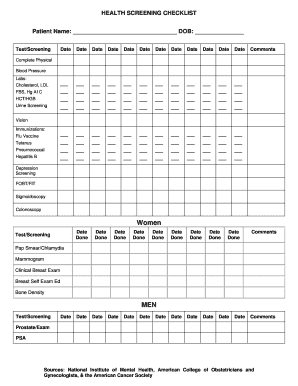
Screening recommendations vary by organization, but the underlying logic is consistent: test when the expected benefit of early detection outweighs the risk of false positives and unnecessary procedures. The table below summarizes widely accepted guidance for average-risk adults.
| Blood pressure | 18 | Every 1-2 years if normal |
| Lipid panel | 20-35, depending on risk | Every 4-6 years if normal |
| Colorectal cancer | 45 | Every 1-10 years, based on method |
| Cervical cancer | 21 | Every 3-5 years |
| Mammography | 40-50 | Every 1-2 years |
| Type 2 diabetes | 35, or earlier with risk factors | Every 3 years if normal |
These intervals are starting points, not universal prescriptions. Family history, prior results, and personal risk factors can shift both the timing and the frequency. A clinician who knows your history is the right person to finalize the schedule.
Pillar Three: Build Daily Habits That Compound
Daily habits are where prevention becomes tangible. The evidence consistently favors a small number of behaviors with outsized effects.
The most reliable way to make these habits stick is to attach them to existing routines. A morning walk after coffee, a set of resistance exercises before a shower, a consistent bedtime alarm. The habit should require as little deliberation as possible.
Pillar Four: Maintain the Maintenance Layer
Some preventive actions are periodic rather than daily. Vaccinations, dental cleanings, vision exams, and skin checks fall into this category. They are easy to overlook because they lack urgency, yet they prevent a disproportionate share of illness and cost.
- Vaccinations: Keep influenza, COVID-19, tetanus, and other age-appropriate immunizations current.
- Dental: Schedule cleanings every six months unless advised otherwise.
- Vision: Get a comprehensive eye exam every one to two years.
- Skin: Perform monthly self-checks and seek professional evaluation for changing moles.
A shared calendar with recurring reminders removes the reliance on memory. Treat these appointments as fixed commitments rather than optional tasks.
Turning the Routine Into a Repeatable Workflow
A preventive routine works best when it operates like a well-designed system: defined inputs, regular checkpoints, and clear ownership. Consider the following workflow.
The quarterly review is the most commonly skipped step and often the most valuable. It creates a natural moment to catch drift before it becomes a trend.
Leveraging Technology Without Overengineering
Technology can support prevention, but it can also distract. The practical middle ground is to use a small set of tools consistently rather than a large set sporadically.
A basic stack might include a blood pressure monitor, a reliable scale, a wearable for activity and sleep, and a secure location for lab results. Automation, such as calendar reminders for screenings or prescription refills, reduces cognitive load. The objective is not to collect data for its own sake but to inform decisions.
It is equally important to recognize the limits of consumer devices. A smartwatch can flag an irregular rhythm, but it cannot diagnose a condition. Use technology as a prompt for professional evaluation, not a replacement for it.
Common Pitfalls to Avoid
Even well-intentioned routines fail for predictable reasons. Awareness of these failure modes improves the odds of success.
- All-or-nothing thinking: Missing one workout or one screening does not invalidate the system.
- Overreliance on a single metric: Steps alone do not capture cardiovascular fitness or strength.
- Ignoring mental health: Depression and anxiety affect adherence and physical outcomes.
- Skipping the clinician: Self-tracking complements professional care but does not replace it.
The most durable routines are forgiving. They accommodate travel, illness, and busy periods without collapsing entirely.
Conclusion: Prevention as a Long-Term Investment
Building a practical preventive healthcare routine is less about discipline than about design. By establishing a baseline, adhering to evidence-based screenings, embedding daily habits, and maintaining the periodic layer, you create a system that works quietly in the background. It does not demand perfection. It demands consistency, review, and a willingness to adjust when the data changes.
The payoff is not merely a longer life. It is a longer period of life spent in good health, with the energy and capacity to pursue the things that matter. That is a return worth engineering for.