Essential Health Screenings for Women: A Comprehensive Guide to Preventive Care
Preventive healthcare represents one of the most powerful tools available to women seeking to protect their long-term wellbeing. While advances in medical technology continue to reshape how clinicians detect and treat disease, the fundamental principle remains unchanged: early identification saves lives. Health screenings empower women to take a proactive stance against conditions that often develop silently, including breast cancer, cervical cancer, cardiovascular disease, and osteoporosis. Understanding which screenings matter, when to schedule them, and how frequently they should occur is essential knowledge for every woman committed to her health.
Why Preventive Screenings Matter
Many of the most dangerous health conditions affecting women produce few or no symptoms in their earliest stages. Breast cancer, for instance, may remain undetectable through self-examination alone until it has advanced significantly. Cervical cancer, driven primarily by persistent human papillomavirus (HPV) infection, can take years to manifest visible signs. By the time symptoms appear, treatment options may be more limited and outcomes less favorable.
Screenings interrupt this trajectory. They detect abnormalities at a point when intervention is most effective, often before a condition becomes life-threatening. According to the Centers for Disease Control and Prevention, regular screening has contributed to substantial declines in cervical cancer mortality over the past several decades. This statistic underscores a critical truth: screenings do not merely identify disease; they change its course.
Core Screenings Every Woman Should Know
Breast Cancer Screening
Breast cancer remains the most commonly diagnosed cancer among women. Mammography, the gold standard for breast cancer screening, uses low-dose X-rays to capture detailed images of breast tissue. The American Cancer Society recommends that women at average risk begin annual or biennial mammograms between ages 40 and 44, with most organizations supporting initiation by age 50 at the latest.
Women with a family history of breast cancer, a known BRCA1 or BRCA2 gene mutation, or prior chest radiation therapy may require earlier and more frequent screening. Magnetic resonance imaging (MRI) is sometimes recommended as a supplemental tool for high-risk individuals. Clinical breast exams, performed by a healthcare provider, can also serve as a complement to imaging, though they are no longer recommended as a standalone screening method.
Cervical Cancer Screening
Cervical cancer screening has evolved considerably in recent years. Two primary methods exist: the Pap test (cytology) and the HPV test. The Pap test identifies abnormal cells on the cervix that could develop into cancer, while the HPV test detects the virus responsible for nearly all cervical cancer cases.
Current guidelines from leading medical organizations suggest the following approach for women at average risk:
- Ages 21 to 29: Pap test every three years
- Ages 30 to 65: Pap test every three years, HPV test every five years, or co-testing (both Pap and HPV) every five years
- After age 65: Screening may be discontinued if prior results have been consistently normal
Women who have received the HPV vaccine should still follow screening guidelines, as the vaccine does not protect against all cancer-causing HPV types.
Cardiovascular Health Screenings
Heart disease is the leading cause of death among women in the United States, yet it is often perceived as a predominantly male concern. This misconception can delay diagnosis and treatment. Blood pressure measurement should begin in early adulthood and continue at least every two years if readings remain normal.
Cholesterol screening, typically via a lipid panel, is recommended starting at age 20 and repeated every four to six years for women at average risk. Those with diabetes, obesity, smoking history, or a family history of early heart disease may need more frequent monitoring. Additional assessments, such as fasting glucose tests for diabetes and waist circumference measurements, provide valuable insight into cardiovascular risk.
Osteoporosis and Bone Health
Osteoporosis, characterized by weakened bones and increased fracture risk, disproportionately affects women, particularly after menopause. Bone mineral density testing, most commonly performed through dual-energy X-ray absorptiometry (DEXA), is recommended for women aged 65 and older. Younger women with risk factors such as low body weight, smoking, or long-term corticosteroid use may benefit from earlier testing.
Additional Screenings to Consider
Beyond the core screenings, women should discuss the following with their healthcare providers:
Screening Timeline at a Glance
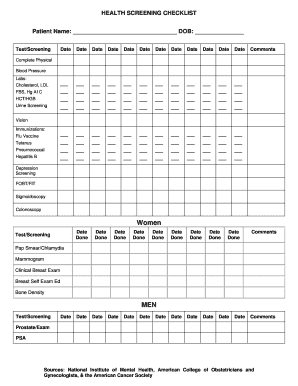
| 20–29 | Pap test, blood pressure, cholesterol | Every 3 years (Pap); every 2 years (BP); every 4–6 years (cholesterol) |
| 30–39 | Pap/HPV test, blood pressure, cholesterol | Every 3–5 years (cervical); every 2 years (BP); every 4–6 years (cholesterol) |
| 40–49 | Mammography, cervical screening, cardiovascular checks | Annually or biennially (mammogram); every 3–5 years (cervical) |
| 50–64 | Mammography, cervical screening, colorectal screening, bone density | Per provider recommendation; colorectal every 10 years or as advised |
| 65+ | Bone density, continued mammography, colorectal screening | DEXA at least once; mammography per provider; colorectal through age 75 |
Overcoming Barriers to Screening
Despite the clear benefits, many women delay or skip screenings due to cost concerns, lack of insurance, anxiety about results, or simply the demands of daily life. These barriers are understandable but surmountable. Community health centers, Planned Parenthood affiliates, and government programs such as the National Breast and Cervical Cancer Early Detection Program offer low-cost or free screenings to eligible women.
Communication with a trusted healthcare provider is equally important. Women should feel empowered to ask questions about which screenings are appropriate for their age, risk profile, and personal health history. A collaborative approach ensures that screening decisions align with individual circumstances rather than a one-size-fits-all model.
The Bottom Line
Essential health screenings are not merely medical appointments; they are acts of self-advocacy. They represent a commitment to catching problems early, when the odds of successful treatment are highest. Women who stay informed about recommended screenings and adhere to a regular schedule position themselves to live longer, healthier lives. Knowledge, consistency, and proactive care remain the cornerstones of women’s preventive health. Schedule the conversation with a healthcare provider today, because the best time to protect your future is now.