
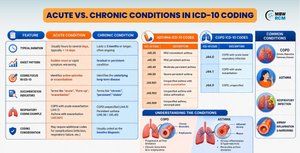
Acute vs Chronic Conditions: Key Differences and Why They Matter
In healthcare, technology, and health informatics, few distinctions carry as much weight as the one between acute and chronic conditions. This classification shapes clinical decision-making, reimbursement models, software design, patient engagement strategies, and public health policy. For technologists building digital health platforms, for clinicians documenting care, and for anyone navigating the modern healthcare system, a precise understanding of these two categories is not optional—it is foundational.
This article breaks down the defining characteristics of acute and chronic conditions, compares them across multiple dimensions, and explores why the difference matters in an increasingly data-driven healthcare landscape.
Defining Acute Conditions
An acute condition is an illness or injury that has a sudden onset, a relatively short duration, and a defined endpoint. The term “acute” derives from the Latin acutus, meaning “sharp” or “sudden.” Acute conditions typically resolve on their own, respond to a short course of treatment, or—in severe cases—result in death within a compressed timeframe.
Common examples include:
- The common cold, influenza, and strep throat
- Broken bones, sprains, and lacerations
- Appendicitis and other surgical emergencies
- Heart attacks and strokes (the event itself)
- Acute bronchitis or pneumonia
From a technology perspective, acute conditions are often managed through episodic care models. Electronic health record (EHR) workflows, urgent care triage systems, and telehealth platforms designed for one-time consultations are all optimized for the acute use case.
Defining Chronic Conditions
A chronic condition is a long-lasting health issue—generally persisting for three months or more—that often cannot be fully cured but can be managed. Chronic conditions may develop gradually, remain stable for years, or fluctuate in severity over time. They demand ongoing care, continuous monitoring, and long-term lifestyle adjustments.
Frequently cited chronic conditions include:
- Diabetes (Type 1 and Type 2)
- Hypertension and cardiovascular disease
- Asthma and chronic obstructive pulmonary disease (COPD)
- Arthritis and chronic pain syndromes
- Autoimmune disorders such as lupus and multiple sclerosis
- Mental health conditions like depression and anxiety
Chronic care is the domain of remote patient monitoring, medication adherence apps, longitudinal data analytics, and care coordination platforms. It is continuous by nature, which makes it both a challenge and an opportunity for health technology.
Key Differences at a Glance
The following table summarizes the most important distinctions between acute and chronic conditions.
| Onset | Sudden and rapid | Gradual or slow |
| Duration | Short (days to weeks) | Long (months to lifetime) |
| Resolution | Usually curable or self-limiting | Often managed, rarely cured |
| Care Model | Episodic, reactive | Continuous, proactive |
| Treatment Focus | Eliminate the cause | Control symptoms and slow progression |
| Cost Pattern | High intensity, short term | Lower intensity, sustained over years |
| Patient Role | Passive recipient of care | Active self-manager |
| Tech Support | EHRs, telehealth, diagnostics | RPM, wearables, adherence apps |
The Gray Zone: When Acute Becomes Chronic
The acute–chronic binary is useful, but it is not absolute. Many conditions begin as acute events and evolve into chronic states. A heart attack is acute; the resulting heart failure is chronic. An acute infection may resolve but leave behind chronic fatigue syndrome. COVID-19 illustrates this perfectly: the initial infection is acute, while “long COVID” is chronic.
For software architects and data modelers, this gray zone is critical. A well-designed health platform must accommodate state transitions—the moment a patient moves from an episodic acute pathway into a longitudinal chronic care program. Rigid systems that assume one or the other will inevitably fail at the boundary.
Why the Distinction Matters in Health Technology
1. Data Architecture
Acute care generates bursty, high-velocity data—vital signs every few minutes in an ICU, for example. Chronic care generates steady, low-velocity streams over years. The storage, processing, and analytics layers must be tuned differently for each pattern.
2. User Experience
A patient with an acute condition needs a fast, focused interface: “What do I do right now?” A patient managing a chronic condition needs a relationship-building interface: trend lines, goal tracking, reminders, and education. Designing one interface for both is a recipe for poor engagement.
3. Reimbursement and Regulation
In the United States, acute care is typically billed through fee-for-service codes, while chronic care increasingly relies on value-based models, chronic care management (CCM) codes, and remote physiologic monitoring (RPM) CPT codes. Compliance teams must understand which category a given service falls into.
4. Artificial Intelligence and Predictive Modeling
Acute prediction models (sepsis alerts, readmission risk) operate on different feature sets and time horizons than chronic progression models (diabetic retinopathy prediction, CKD staging). Training data, label definitions, and evaluation metrics diverge sharply between the two.
Practical Implications for Patients and Providers
Understanding the acute–chronic distinction empowers better decisions at every level:
Conclusion
Acute and chronic conditions are not merely two labels on a spectrum—they represent fundamentally different care paradigms. Acute conditions demand speed, precision, and episodic intervention. Chronic conditions demand continuity, engagement, and sustained coordination. In the technology sector, where digital health tools increasingly mediate the patient–provider relationship, recognizing this difference is the first step toward building systems that actually work. The best platforms do not force patients into a single mold; they adapt to the reality of the condition, meeting each person where they are on their health journey.